Musty smell, damp walls or water on the basement floor?
Basement moisture has different causes from leaks upstairs: water from the soil outside, summer condensation, plumbing, or drainage around the house. A Focused Moisture Investigation looks at one defined basement concern inside and out, so you know which cause the evidence points to and who to call.
Signs people notice in a basement
Smell
A musty or earthy smell
Often stronger in summer or after rain, and in storage rooms or under stairs where air moves less.
Walls
White deposits, stains or peeling paint
A white, chalky deposit (efflorescence) on concrete or block shows that water has moved through the wall at some point and evaporated.
Floors
Water at the wall-floor joint
Damp lines or puddles along the base of a wall, around a floor crack, at a floor drain or near a window well after heavy rain or snowmelt.
Finished space
Damp baseboards or swollen flooring
In a finished basement or basement apartment: stained drywall near the floor, lifting laminate or carpet that feels damp.
Who this is for: homeowners, landlords with a basement unit, and property managers responding to a tenant's concern. If you are buying a home with a basement apartment, read our basement apartment guide; basement moisture checks are already part of our home buyer inspection.
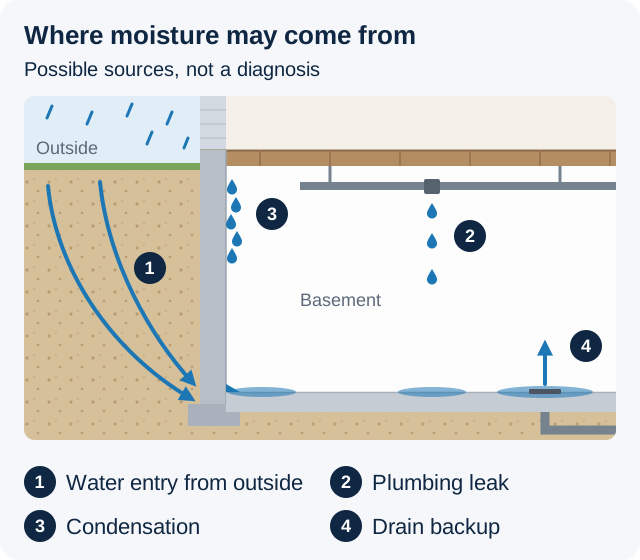
Four common sources of basement moisture
1. Water from outside
Rain and snowmelt that collect against the foundation can find their way through cracks, tie-rod holes, the joint between the wall and floor, and window wells. Ground that slopes toward the house and downspouts that empty next to the wall make this more likely.
2. Condensation
In humid summer weather, warm basement air meets cool foundation walls, cold-water pipes and ductwork, and water condenses on them. This can look like a leak, but the fix is managing humidity, not waterproofing. Health Canada recommends keeping indoor relative humidity between 30% and 50%.
3. Plumbing and appliances
Supply lines, drains, water heaters, softeners, laundry connections and the furnace's condensate line can all leak slowly where nobody looks.
4. Water coming up through drains
Water backing up through a floor drain during a storm is a sewer or drainage issue rather than a wall leak. Inspecting sewer lines is outside our scope, but some municipalities offer programs that help, such as the City of Toronto's basement flooding protection subsidy and Peel Region's backwater valve rebate.
What JBM Inspect looks at for a basement concern
- The affected area and the foundation walls and floor we can see, including cracks, stains and efflorescence.
- Pinless and pin-type moisture-meter readings at the affected area and at comparison areas.
- Thermal imaging of finished walls and floors to help map suspect areas before taking readings.
- Outside: grading next to the foundation, downspout discharge, window wells and visible foundation, where accessible.
- Visible plumbing, the water heater and other appliances in the area.
- Visible signs that point toward condensation rather than water entry, such as dripping cold pipes or moisture on duct surfaces.
What thermal imaging can and cannot establish in a basement
- Patterns on finished walls and floors consistent with dampness, which we then check with a moisture meter.
- The shape and extent of a suspect area, for example along the base of a wall.
- Temperature differences at pipes and ducts that help tell condensation from a leak.
- The condition of the foundation wall, insulation or framing behind a finished wall.
- That the outside of the foundation is waterproofed, or that it will stay dry next spring.
- Moisture from the image alone. Walls and floors in contact with the soil are naturally cooler than the room, and the strip near ground level changes with the weather outside, so cool patterns are common and need corroboration.
- Whether mould, radon or a sewer problem is present.
How findings are reported
Each item in the report is labelled, so you can tell dampness that the evidence supports from signs of past or possible water.
| In the report | What it means | Example (illustration, not a client finding) |
|---|---|---|
| Observation | What was seen, photographed or measured, with the conditions at the time. | White deposits along the base of the foundation wall, and a cooler strip on the finished wall above them. |
| Possible explanation | What the observation is consistent with. Usually more than one explanation fits, and the report says which. | Consistent with water entering at the wall-floor joint at some point, or with past condensation. |
| Confirmed finding | Stated only when separate lines of evidence agree, such as visible water, or consistently elevated readings compared with the same material elsewhere plus a matching thermal pattern or staining. On concrete and masonry, meter readings are comparative and mineral salts can raise them, so a single elevated reading is reported as an observation, not as proof. A dry reading on the day does not rule out a seasonal problem. | Readings at the base of the finished wall stay elevated at several points with both meter types, readings on the same wall away from the area are normal, and the area matches the cooler strip. Together these support a finding that the lower wall is damp at the time of the visit. The entry point is not confirmed unless it can be seen. |
Timing and limits
- Basement leaks are often seasonal. Water entry usually shows during spring thaw or after heavy rain; condensation shows in humid summer weather. If the area is dry on the day, readings may be normal even though a problem exists. Photos and dates of when it happens are very helpful.
- Finished basements hide a lot. We do not remove baseboards, drywall, flooring or stored items. Where opening a surface is the only way to confirm a concern, we say so.
- One defined concern, up to 75 minutes on site. For example, one damp wall or one area of the floor. Additional time is only with your approval. Widespread moisture after a flood, or documentation for an insurance claim, usually needs a wider scope, which we quote separately after discussing the affected areas and how the report will be used.
- Outside our scope: sewer camera inspections, radon testing, mould sampling, structural engineering and waterproofing design. We recommend the right specialist when the evidence calls for one.
Focused Moisture Investigation: $279 + HST
A focused diagnostic service. It does not include a complete home inspection.
This is the moisture option of our Single-Concern Assessment: one localized concern, agreed before booking, at one price for any property type.
- Up to 75 minutes on site for one defined concern or connected affected area, agreed before booking.
- Visual assessment of the accessible affected area, with thermal imaging and moisture-meter readings where appropriate.
- Photographs and a concise written findings report, within two business days.
- Recommended next steps, such as grading and downspout changes, a plumber, a waterproofing contractor, or humidity control.
Plus 13% HST. Additional investigation is $125 per hour, billed in 30-minute increments, only with your approval. Any additional reporting fee is agreed in advance. Travel adjustments may apply.
In short: a basement moisture concern is assessed as a JBM Inspect Focused Moisture Investigation for $279 + HST: up to 75 minutes on site, inside and outside checks, thermal imaging and moisture-meter readings, and a written report within two business days. It helps tell water entry from condensation or plumbing, but it is non-invasive and cannot confirm what is behind finished walls.
Basement moisture FAQ
Is this a Single-Concern Assessment?
Yes. Focused Moisture Investigation is the moisture option of our $279 + HST Single-Concern Assessment: one localized concern, up to 75 minutes on site, and a concise report within two business days. A whole-home survey or wider post-flood investigation needs a different agreed scope.
Is it a leak or condensation?
It can be either, and the fix is different. Condensation is most common in humid summer weather and shows on cool surfaces such as cold-water pipes, air-conditioning ducts, the concrete floor and foundation walls. Water entry tends to follow rain or snowmelt and often appears at the base of walls, at cracks or near window wells. The investigation looks for the evidence that separates the two.
Can thermal imaging see water behind my finished basement walls?
No. It shows surface temperature patterns. Damp areas often appear cooler, but walls and floors in contact with the soil are naturally cooler than the room too, so we check suspect areas with a moisture meter before drawing conclusions. What is behind the drywall can only be confirmed by opening it.
Do you check sewer lines or test for radon?
No. Sewer camera inspections and radon testing are outside our scope. If the evidence points to drain backup, we recommend a qualified plumber or drain specialist.
Will you tell me if I need waterproofing?
We report what the evidence shows and the likely cause, and point first to simpler measures such as grading, downspouts and humidity control where the evidence supports them. Waterproofing design and quotes come from a waterproofing contractor or, for structural concerns, an engineer.
When is the best time to book?
When the problem is happening, or soon after: during spring thaw or after heavy rain for water entry, and during humid summer weather for condensation. If it is dry on the day, the results are limited.
Related services and reading
Helpful reading: buying a home with a basement apartment, basements in older Toronto houses, and what thermal imaging can and can't show.
Damp or musty basement?
Tell us what you notice and when: after rain, during thaw or in humid weather. We'll confirm the scope and total price, and the best time to look.